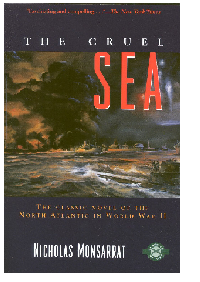
This book literally
changed my life.
In the eleventh grade in Greenville, South
Carolina, i had an English teacher who
designated Thursday as "Free Reading Day" and
encouraged the entire class to read anything
they wanted to (well, within limits --
"Playboy" would have been Right Out, i'm sure)
-- and, in case you had nothing of your own,
she laid out an assortment of magazines and
books on a table at the front of the room.
On that table, one Thursday, was a copy of
"The Cruel Sea". Since i've always been at
least a bit interested in sea stories, and it
looked interesting, i picked it up. From the
first i was hooked solidly.
In the next three or so years, i reread it
twice at least, possibly more than that.
And then i joined the Navy -- and i am sure
that it was because of what i read in this
book, and what i sensed behind it, in what
Monsarrat -- who, like his viewpoint
character, Lockhart, was there from the
beginning, working his way up to command his
own ship before the end of the war -- didn't
so much say as assume about the sea and the
Navy -- any Navy.
Monsarrat presents us here with a brotherhood
of the sea, corny as that idea may sound.
Sailors, more than the other Armed Forces,
tend to regard other sailors -- even enemy
sailors -- as brothers in arms, and, as
Monsarrat says, the only true enemy is the
cruel sea itself.
As he shows us here, the sailor who was your
enemy five minutes ago, who was trying to kill
you as you tried to kill him, is merely
another survivor to be rescued from the cruel
sea once you've sunk his ship.
And, even more so, as Monsarrat portrays it,
there is a kind of brotherhood that binds
sailors in the same Navy together in very much
a family manner -- you may not like your
cousin, but you want to know what's happening
to him and, when all is said and done, he IS
your relative.
The best summation of this sort of attitude
(which i felt to some extent myself during my
time in the US Navy) comes when Ericson, the
Captain, is touring his new ship as she stands
under construction in a Glasgow shipyard; he
meets one of his future officers, and mentions
the name of his previous ship, which was lost
with over three-quarters of her crew, and
realises that
"He's
heard about Compass Rose, he
probably remembers the exact details--that
she went down in seven minutes, that we lost
eighty men out of ninety-one. He knows all
about it, like everyone else in the Navy,
whether they're in destroyers in the
Mediterranean or attached to the base at
Scapa Flow: it's part of the linked feeling,
part of the fact of family bereavement.
Thousands of sailors felt personally sad
when they read about her loss; Johnson was
one of them, though he'd never been within a
thousand miles of Compass Rose and
had never heard her name before."
To be part of a band of
brothers like that is a proud thing, and
Monsarrat captures it perfectly.
He also captures the terrified boredom of
being in enemy territory with nothing
happening as you wait for the enemy to make
the first move, and the shock, confusion and
horror of combat (particularly sea combat,
in which the battlefield itself is the
deadly, patient enemy of both sides).
And he captures the glories and rewards of
life at sea, the beauty of a glorious clear
dawn at sea, the stars and the moon and the
wake at night and so much more.
This is the book that made a sailor out of
me.
It will tell you what it is to be a sailor.
|